Friday, 9 June 2017

A little activity on 4m, getting there slowly this year..

Keep an eye out via the following link:   
https://www.dxmaps.com/spots/mapg.php?&HF=N&ML=M&Frec=70&Map=EU


Sunday, 5 March 2017

EI4FMG back on test.


For those of you within the area of County Louth have a listen for EI4FMG on 70.350, it is only on beacon mode at the minute, giving it's callsign out every 5 minutes.
It would be interesting to see what distance it will cover, any reports from Northern Ireland and the UK will be greatly appreciated..

Saturday, 2 July 2016

Andorra on 4m.


C37MS.


Jean-Jacques, ON7EQ, writes that through the help op Joan, C31US, President of URA, that on 16 June 2016 4 m band has been allocated in Andorra from 70,000 MHz to 70,200 MHz, power 10 W, all modes, on a ''non-interference basis''. Jean-Jacques will operate on 4 m during next Perseids (August 12th-14th) with call sign C37MS.

Jean-Jacques, ON7EQ.


Tuesday, 28 June 2016

Long time no post!!!

It has been a while since I updated the blog, mainly because I have been so busy at work, "no mun no fun", however I have been keeping an eye on the activity on 70 Mhz and it is nice to see so much activity.
I even bought myself a Spectrum Communications transverter, connected it up and unfortunately have not the time to operate it, I have not been totally off radio though, I have had a few hours now and then to spend on HF using PSK, handy if you are like me not inclined to be calling for hours to make a contact (if I had the morse I could be using that as well...).
But now I will be having a lot of free time but I will not be in this part of the world, I am heading to VE7 on monday for 5 weeks and of course they do not use 4m over that part of the world..
Below is a snapshot of the activity on 70 Mhz today, keep up the good work folks and I will be keeping an eye out on the 4m activity from the East Coast of Canada...


Sunday, 19 June 2016

My first PSK contact on 70 Mhz.


Myself and Aidan were chatting on 2m the other day and the conversation came up about PSK, I have been spending a bit of time using that mode of late and making a lot of contacts, however there seems to be no PSK activity on 4m.
So we arranged a sked and made a contact to what is my first ever PSK contact on 70 Mhz.
So here is the thing, as a test I used 70.2125 DIGI on my Yaesu FT-857D through my Spectrum Communications Transverter, so the question is as to what the correct PSK frequency should be??
Looking at the UK bandplan for 70 Mhz it shows 70.100 to 70.250, here in Ireland the band starts at 70.125 so maybe we could adopt 70.2125 as the PSK frequency???? If so I would like to call out and maybe make some more contacts using PSK31 on 70.2125. (any comments??)


Sunday, 15 May 2016

Celebrating 60 years (1956-2016) of the 4 metre band (70MHz) in the United Kingdom!

GB4MTR


Great Britain will be celebrating 60 years of 70 Mhz use by radio amateurs this year.
The special callsign of  GB4MTR will be used.
This callsign was used as a special event callsign for 28 days in 1986 in order to promote the 4m band.


Now in 2016, 30 years later, there will be another chance to work this special callsign again.
Interesting that the band was considered "under-used and underestimated" then!
The comment at the bottom reads:

"1987 - band extended to 70.00MHz & class B operation".

Meaning that it then became available to those who hadn't passed the 12wpm Morse test.
So get on the air and celebrate 60 years (1956-2016) of the 4 metre band (70MHz) in the United Kingdom!
The station will be on the air from November 2016,more information below from Selim M0XTA

"I have information and good news for everyone!
GB4MTR
A special event station celebrating 60 years of the 4m (70MHz) band!
This special event station will be operational from the 1st November to the 28th November run by the Harlow and District Amateur Radio Society from the club house in Harlow, Essex
The official date of the anniversary Is 9th November 1956.
We will be operating from 80m right down to 70cm.
I feel the 4m band is a special and unique band because in recent years it originally went from a British only band to a European wide band + some countries outside of Europe too!
I really would like to see more activity and more people on the 4m band and of course on all VHF/UHF bands.
I hope my previous article has helped activity increases all over the UK. So far, down here in the south...no effect.
But yes, please make our special event station known and we hope to work many stations with our Callsign.

Selim M0XTA"

Monday, 9 May 2016

CQ CQ CQ 70 Mhz SSB..


Here it is, my new addition to the shack, the Spectrum Communications TRC4-2sL Transverter… it has been a while since I have been active on 4m SSB but at long last I will get active again. I seen the transverter for sale on Facebook, I was not exactly looking out for one but this was at a good price and was the one I was looking for, input on 2m and the output on 4m… I organised buying it and picked it up at the Lough Erne Radio Rally yesterday.
There is no need for me to go into detail about the specs on this as they are well documented elsewhere on the internet and are very highly regarded..
I will be getting a 3 element beam up for SSB and the plan is just to point it into central Europe and leave it fixed there for the rest of the year.
Seeing that I will be using my Yaesu FT857D into the transverter and that I have a digital interface connected which I use on HF for PSK, I hope to have some contacts using PSK on 70 Mhz as well.
The last time I was on 70 Mhz SSB was nearly 4 years ago...  time to catch up on a bit of DX...


I had a quick look on “DX Maps” to see if there is any activity but there is nothing showing there at the minute but the "Cluster" is showing a little activity…

Let’s hope it will get better.


Monday, 2 May 2016

SPECTRUM COMMUNICATIONS TRC4-2s.


I have just purchased one of these to add  4 meters to a rig 2 meters, I am going to use my Yaesu FT857D on 5 watts, this should give me about 25w or so on 4m.
The beauty of this is that I do not need to worry about the HF end of the radio, this I use for mostly digi modes on HF, and seeing that I do not use the VHF/UHF end of the Yaesu then the 2m to 4m transverter seemed like the answer.
So next will be to get my hands on a beam to use on 4m and get that in the air as soon as I can, and hopefully hear some activity when the band opens…
The transverter main board contains an attenuator in the transmit path and can be configured for 1-500mW or 0.5-5W drive levels and gives 300mW output. Class AB linear operation gives all mode use.   The standard product includes a linear amplifier giving panel adjustable output 5 to 25W on 4m.  All spurious and harmonic outputs better than 45dB below carrier.  Capable of withstanding long periods of transmit into bad SWR.  Receive side has panel adjustable gain 0-20dB gain and NF less than 1.5dB.   

Saturday, 9 April 2016

Latest edition in the shack Icom IC-7300


I just got a loan of a spanking new shiny Icom IC-7300 to test and review... I will be putting it through it's paces over the next week or two...
As soon as I can drag myself away from it I will do a review and post it here.... if you do not see anything in a few weeks do not panic, I will not have forgotten, it just means that I have not been able to keep my hands off it, I will probably be like a man with a new bride for a while....

Sunday, 3 April 2016

Quad band 6m/4m/2m/ and 70cm colinear

Here is a nice small home base antenna for 6m/4m/2m and 70cms, also it would be ideal for portable work:
Quad band 6m/4m/2m/ and 70cm colinear only 1.2m in length.  Great for locations where visual impact is a problem, this antenna gets you on the 4 most popular VHF bands. Supplied with antenna, radials, mast supports etc
Click on the following link for details on ordering etc: Mirfield Electronics


Thursday, 17 March 2016

EI4FMG live audio streaming.

EI4FMG has been up and running for the past few weeks now and getting plenty of use, it has been decided to stream the audio via RadioReference.com
You can also listen to the audio by clicking on this LINK or by going to the Dundalk Amateur Radio website www.ei7dar.com. and clicking on the "A.L.A.R.M. link in the middle of the page, this will bring you to a second page which will let you listen live to EI4FMG.


Wednesday, 10 February 2016

Tweaking EI4FMG.

I was up today at the EI4FMG site having a look as to why it was not sending it's ID or giving a "K" when it received a signal.
I am not sure as to why but the computer did not log back on to the Wi-Fi on site and did not show up on echolink.
So after moving the computer to a higher shelf and restarted the computer and got it back up and running.
A length of coax has been ordered so that I can extend the Wi-Fi antenna attached to the computer to outside the compound and therefore get a better Wi-Fi connection.
Probably the best thing to do would be to connect a CAT5 cable from the router over to the gateway computer, with the hope that it does not get the same interference as before (RF down the CAT5 Cable)
The gateway is back up and running again, and I connected to Conference NASA to relay the activities of the astronauts on board the ISS. 


International Space Station Audio streaming live via EI4FMG, there may be "quiet times" where no audio is being transmitted, to listen go to EI4FMG - 70.350 Mhz FM.

So true......


Wednesday, 3 February 2016

OZ7IGY – The World's Oldest Beacon.


OZ7IGY dates back to the International Geophysical Year in 1957. From its start on 144 MHz it has been on air on more and more bands. Today OZ7IGY transmits on 28 MHz, 40 MHz, 50 MHz, 70 MHz, 144 MHz, 432 MHz, 1,3 GHz, 2,3 GHz, 3,4 GHz, 5,7 GHz, 10 GHz and 24 GHz. In the past most of the equipment was modified land mobile equipment. For the microwave bands most of the technology was dedicated radio amateur beacon designs and power amplifiers surplus. Today most of the OZ7IGY beacons use the Next Generation Beacons platform.


GPS + PI4 beacons use a 60 s mixed mode sequence (PI4, CW and carrier). Otherwise a ~40 s sequence is used (CW and carrier). Over time the remainder of the OZ7IGY beacons will be GPS locked and use the Next Generation Beacons platform too. The PI4 signal on 24 GHz is PI4-96 otherwise PI4 is used.


On 30 October 2012 the first two Next Generation Beacons were put on air. The Next Generation Beacons platform is open to others and the software can easily be adapted to other modulations and sequences. Furthermore, is the new platform frequency and time locked to GPS. Thus the frequency accuracy is better than 5 Mhz. Emanuele, IW9GDC and beacon manager of IW9GDC/B that also uses the Next Generation Beacons platform says: “… I can really say that this hardware is actually the best ever made … 4 km straight line and cannot detect any issue with the signal.”


Sunday, 31 January 2016

70 MHz Maidenhead Locator Award (MLA) program.


DEFINITIONS:
For the purposes of this document describing the 70 MHz Maidenhead Locator Award (MLA) program the following terms shall have the following meanings.
“Maidenhead Locator (Locator)”: means the first four characters of the six character geographic coordinate system originally devised by Dr. John Morris, G4ANB, and approved by a group of IARU R1 VHF managers at a meeting in Maidenhead, England in1980. Maidenhead locators are also referred to as QTH Locators, Grid Locators or Grid Squares.
GENERAL IRTS issues MLA certificates to amateur radio stations around the world concerning international amateur radio communications in the 4m band.
The purpose of the MLA program developed by Dave Court, EI3IO is to recognise and promote DX achievements by amateur radio operators licensed to use frequencies in the range 69 – 74 MHz, (4 metres). In general the 4m band is limited to a relatively small but growing number of countries, mainly in Region 1 (Europe, Africa and the Middle East) and Region 2 (North America) of the International Telecommunication Union (ITU). 4m stations are or have been active in over 50 territories in Africa, Asia, Europe and North America.
A second objective is to stimulate an interest in the 4m band in countries which are not authorised to transmit in the range 69 – 74 MHz, by encouraging cross-band working to frequencies in the vicinity of 50.285 MHz and 28.885 MHz, which are recognised centres of cross-band activity.
IRTS reserves the right to amend the qualification criteria for the three levels of MLA award.
AWARD
Three MLA levels are available, the entry grade Half Century award, the Century award and the Double Century award are offered, based on the number of confirmed communication with stations in different Maidenhead locators by:
In band two-way working of amateur and associated experimental radio stations in the 4m band or Cross band working of amateur and associated experimental radio stations in the 4m band by two way in-band working, and for stations not authorised to use 4m, cross-band working to 4m from 6m or 10m, or a combination of cross-band and in-band working.
The awards will be designated In-Band or Cross-Band.
QUALIFICATION
Qualification for a MLA is based on an examination of a log extract and accompanying certification by the IRTS Awards Manager, which certifies that the applicant has made 70 MHz QSOs with amateur stations in the required number of Maidenhead Locators. All log extracts must show the mode, must mention the 4m or 70 MHz band and if a cross-
band QSO, in addition 6m (50 MHz) or 10m (28 MHz). Furthermore, the log extract must clearly show the Maidenhead Locator claimed in its 4 or 6 character form.
Requirements for MLA Awards
For the 70 MHz MLA in-band Half Century award, communicating with stations in 50 locators is required, 75 for a cross-band award.
For the 70 MHz MLA in-band Century award, communicating with stations in 100 locators is required, 125 for a cross-band award.
For the 70 MHz MLA in-band Double Century award, communicating with stations in 200 locators are required, 250 for a cross-band award.
A Double Century Award can also be endorsed for additional locators worked in steps of 50 e.g. 250, 300, 350 etc.
It is of course possible for stations licensed to transmit in the 4m band to hold both cross-band and in-band MLA awards.
QSO VALIDATION
A claim for all in-band or cross-band MLA awards and additional endorsements to a Double Century award must be accompanied by a certified log extract (see below), to include date, time, frequency (in the case of a cross-band award), mode, station worked and Maidenhead locator.
CONDUCT
All QSOs must be made with licensed amateur stations working in the authorised 4m allocation within the frequency range 69 – 74 MHz or with other stations licensed or authorised to communicate with amateur radio stations. Contacts made through repeaters or satellite transponders are not permitted for MLA credit. However Earth-moon-Earth (EME) QSOs are acceptable. In addition: All 4m operations should take place in accordance with the regulations pertaining in that jurisdiction. All stations contacted must be located on the surface of the Earth. QSOs with aeronautical mobile stations cannot be credited. Stations located in ‘wet Maidenhead Locators’ by means of stations located on off-shore platforms or maritime-mobile stations installed on boats, ships or other floating objects can be credited. All stations must be contacted from the same locator.
It is a condition of the MLA award that the person applying unreservedly agrees: To observe all pertinent regulatory requirements for amateur radio in the country or countries concerned. To observe all rules applying to the MLA award process. To accept the decisions of the IRTS awards manager.
APPLICATIONS
All applications shall be made electronically. An email shall be sent to the Awards Manager ( Awards at irts.ie ) which clearly indicates the category of in-band or cross-band award required (e.g. Half Century, Century, Double Century or endorsements to a Double Century award) and the number of claimed Maidenhead Locators to qualify for the award. The email address of the applicant should also accept incoming emails in case of a query. A log extract, shall be attached to the email certified as a correct extract from the claimant's log by an officer of a Radio Club or by two licensed radio amateurs. The log extract should also
include the Maidenhead Locator claimed for each QSO. The certification of the log extract may be attached to the email as a JPEG image of a scanned document.
Please address all correspondence and inquiries relating to MLA awards and all applications to the Awards Manager ( Awards at irts.ie )
FEES
There are currently no charges levied for the issue of MLA awards and endorsements.
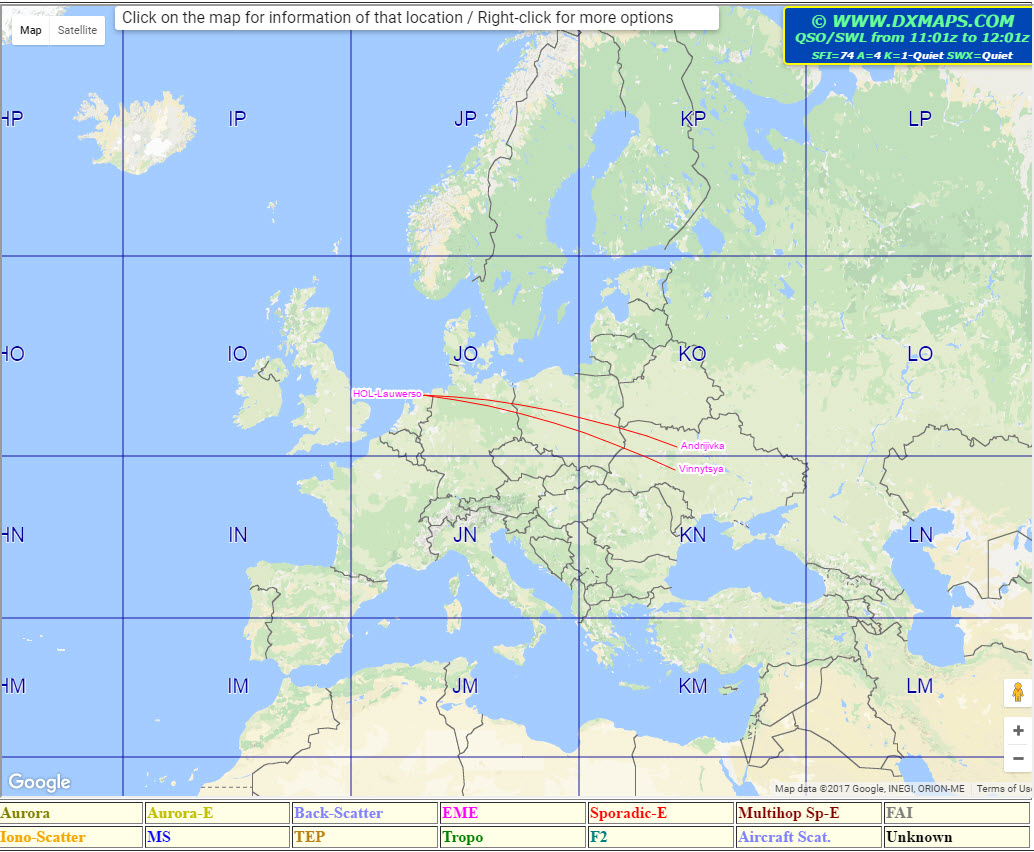
Monday, 25 January 2016

Simoco SRM9000 Programming revisited.


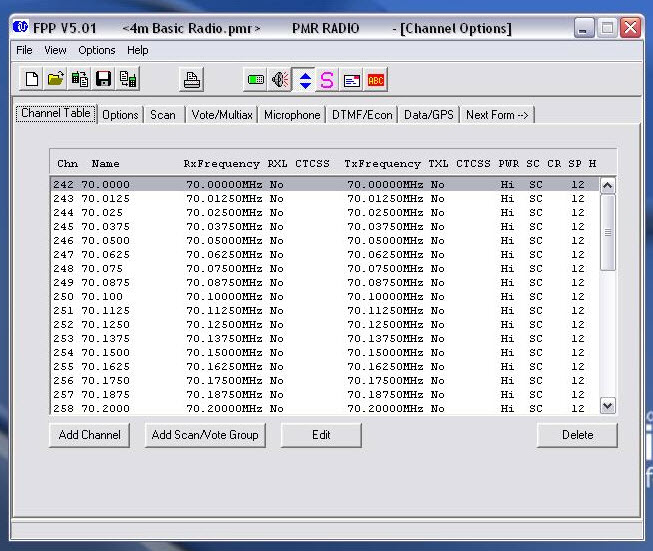
A while ago I reviewed the programming software for the Simoco SRM-9000. On that blog I said that I would upload the software so that it would be available to others and they can get their Simoco SRM-9000’s up and running on 4m (or 2m/70cms).


Picture of my 9030 plus control head which I use on my SRM9000 in car on 2m.

So here is a recap of that post:

To program the radios you will have to get the appropriate lead, these can be found on eBay for about £10 or so and of course the software.


You will see a few screen shots of the software screen in action. I have the whole 4m band already programmed in 70.000 to 70.500 in 12.5 KHz steps and power output is 25 Watts High and 5 watts Low. The SRM can only scan a batch of 15 Channels at a time so I have programmed in the most popular 15 Channels, also several more “batches” of 15 channels can be programmed in to cover a various Pick and Mix to suit, these “Scan Bands” can be named i.e.: Scan1, Scan2 etc. or whatever you like and when the radio is in Scan mode the Scan band required can be changed by the Channel up and down buttons.
The Memory/Call channel button I have programmed to my local net frequency which is 70.400, this puts the radio on a handy “near” middle of the band, to access channels that are not in the “SCAN” batch all I have to do is press the Channel Up/Down buttons to get to where I want to transmit. The Squelch Level can be adjusted up and down with these same buttons, or turned down and off completely if I want to hear a very weak signal.

If you need a copy of the FPP V5.01 software please feel free to download from:

This programming software will NOT run on windows 7, 8 or 10.

If you need further assistance please email me:

Tuesday, 19 January 2016

EI4FMG update.


EI4FMG is back up and running, it is giving out it’s callsign and location in CW every 10 minutes, it does not have a stable internet connection at the minute but that will be sorted out over the next while.
To see if you can hear it listen on 70.350 Mhz FM, if you want to see if you are able to access it call out your callsign for about 5 to 10 seconds, if the gateway can hear you it will respond with the letter “K” in CW. Do not forget to ensure that you have a CTCSS of 88.5hz on transmit.

Monday, 18 January 2016

Approve 70 MHz Amateur Band for Australia.


Closure of Analogue TV has removed Channel 2, including the stereo audio sub-carrier from spectrum around 70 MHz.  Also called "4 metres" for its approximate wavelength, this band is available to Amateurs in much of Europe, and parts of Africa and the Middle East.

The UK is the pioneering user of this band, where the band covers all of 70.000 to 70.500 MHz.  Many other Region 1 countries now have allocations part or most of the 69.900 to 70.500 MHz range, in some cases in several segments.
Benefits of access to the band include an improved understanding of radio propagation, including TEP (trans-equatorial propagation), and provide new challenges (opportunities) to Amateurs.  The band also has value to the emergency communications support groups within the Amateur community.

A range of equipment is available, including converted ex-commercial or ex-government radios, Japanese Ham equipment (eg: ICOM), and Chinese products, and a new European brand (Noble), along with home built transverters.


Thus we ask the ACMA makes an Amateur allocation in this band.

Sunday, 17 January 2016

EI4FMG still on test, but not for much longer..


EI4FMG on test in my Shack.
I have not posted about the 4m Gateway EI4FMG in a while, that’s because I have been having a small issue with it and it took a while and a bit of head scratching to sort it out.
The gateway works perfectly when on test in my shack, but as soon as I bring it to site it plays up and picks up a steady noise level on the interface when everything is connected up.
I brought it up to a friend’s QTH recently with a view of leaving it there on test and see how it behaves but the issue was still there, after turning off his electricity in his house and connecting a portable generator the problem was still there.
So we disconnected everything and brought it home, set it up in my shack on a dummy load and it was fine!!!! 
I reckoned it was an grounding  problem and went through it all again, took it off my power supply and put it on a temporary power supply  and the problem returned, so all I done was connect a wire from the chassis of the radio to the chassis of the computer and the noise disappeared.
So now the plan is this week to locate the gateway to a secondary testing location, it will probably only be on beacon mode for a while to ensure that it keeps performing to proper parameters.

Tait TM8110, Altai 5-7amp Power supply, EI4JR interface.
On test.
When the gateway returns to service it will be operating from a new radio, a TAIT TM-8110, running 15 watts and an Altai 5-7 amp power supply, also updated is the computer, the old one became faulty; the sound card started to play up and did not want to accept any input audio…

The interface by EI4JR will still be used, the gateway node number is still the same: 57006.